
India’s Suspension of Indus Water Treaty an "Act of War," Warns Pakistan
India’s Suspension of Indus Water Treaty an "Act of War," Warns Pakistan
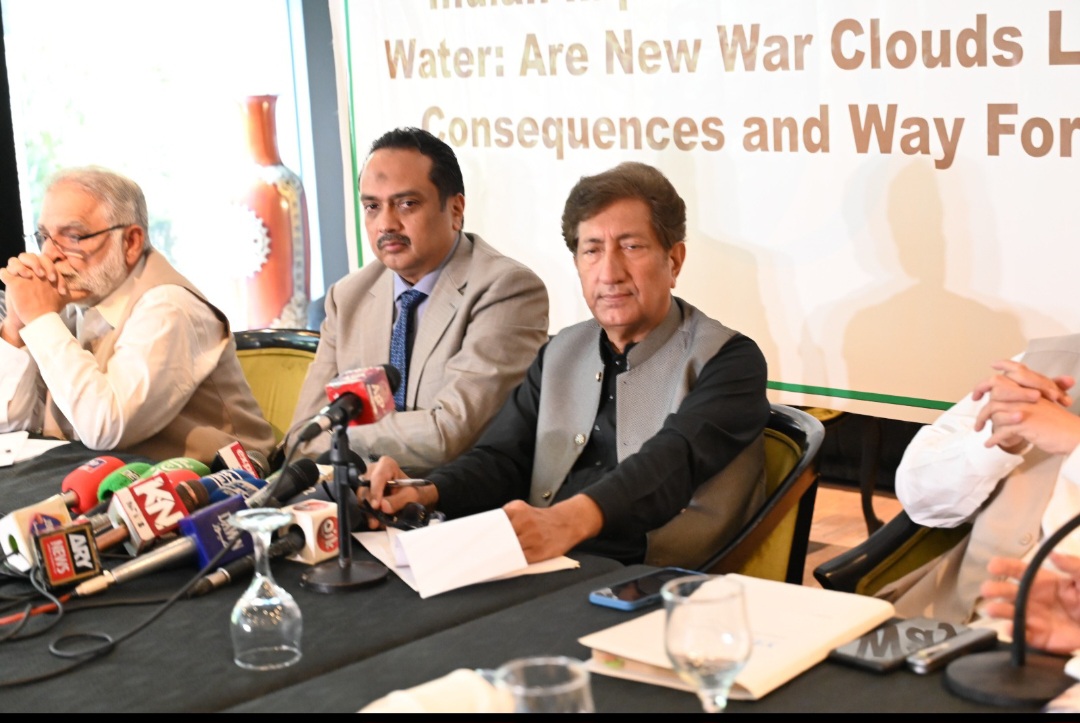

LAHORE: Federal Minister for Water Resources Muhammad Moeen Watto on Saturday
unequivocally declared that India’s unilateral decision to suspend the Indus Water Treaty (IWT) constitutes an "act of war." Stressing that water is a lifeline for 250 million Pakistanis, Watoo vowed that Pakistan would vigorously defend its people’s interests and pursue the water dispute to its final resolution.
The minister made these remarks during a seminar titled "Indian Imperialism on Pakistan’s Water: Are New War Clouds Gathering? Consequences and the Way Forward," organized by the Institute of International Relations and Media Research (IIRMR) at a local hotel.
Expressing deep skepticism about India’s motives, Watoo warned of New Delhi’s sinister intentions to manipulate water flows and called for heightened vigilance. However, he noted that Pakistan has so far observed normal water inflows from India, describing it as a positive development.
Accusing India of premeditated malice, Watto revealed that New Delhi had sent a letter on April 18 regarding water-sharing issues, demanding a response by May 8. Yet, without waiting for Pakistan’s position, India abruptly announced the suspension of the IWT. The minister asserted that under international law, the treaty cannot be unilaterally annulled or suspended.
IIRMR Chairman Muhammad Mehdi said that India lacks the capacity to completely cut off water to Sindh, as only five percent of its flow originates from Indian-controlled sources. The same applies to the Jhelum River, he added. He predicted that any disruptive efforts would likely target the Chenab River, though such measures would take years to implement.
The IIRMR Chairman emphasized that the IWT is a critical test case for global treaties, warning that its violation could undermine the sanctity of all international agreements. They also highlighted China’s role in regional water management, given that major rivers originate in Tibet. Additionally, they urged the United States, which initially mediated the treaty, to intervene and facilitate a swift resolution.
Former Indus Water Commissioner for Punjab, Sheraz Memon, dismissed India’s threats as futile, arguing that New Delhi lacks the infrastructure to significantly alter water flows into Pakistan. He noted that the IWT has endured two wars and persistent tensions, calling for both nations to uphold the agreement despite political disputes. Memon stressed the need for Pakistan to engage the World Bank and neutral experts under the treaty’s dispute resolution mechanisms to protect its water rights.
Former Punjab Irrigation Minister Mohsin Leghari categorically rejected the possibility of a unilateral suspension of the IWT, warning that such a move would set a dangerous precedent, rendering all international treaties meaningless. He also cautioned that India would face massive financial costs if it attempted large-scale water diversion projects, which could ultimately threaten its own water security.
Former Indus Water Commission officials Asif Baig and Shafiq, an ex-chief engineer of Punjab’s Irrigation Department, noted that India itself is bound by transboundary water agreements with China, Nepal, and Bangladesh. They warned that if India exploits its upstream position against Pakistan, China—which controls the headwaters of key rivers flowing into India—could apply the same logic.
From a legal and technical standpoint, they argued, India’s threats to suspend the IWT are baseless, as the treaty is a bilateral agreement requiring mutual consent for any modifications. Citing Article 12(4) of the IWT, they emphasized that termination is only possible through written agreement by both parties. The officials underscored that the treaty has withstood decades of conflict, demonstrating its resilience and international legitimacy.

No comments yet.