
Reflections on Leadership: My Meeting with Senate Chairman Yousaf Raza Gillani
By Sania Kamran, Former MPA and Pakistan Peoples Party Leader
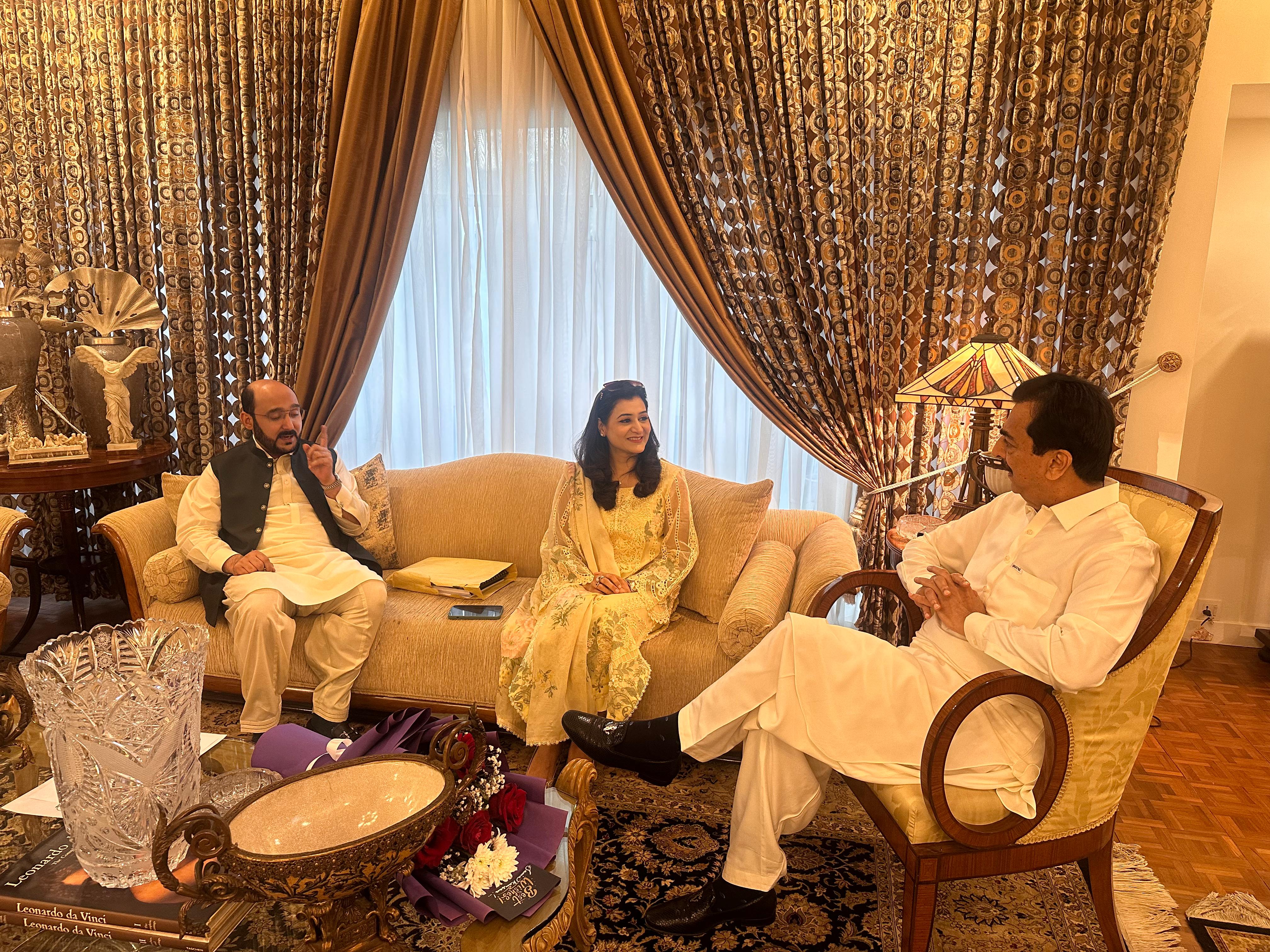
There are moments in political life when you find yourself in the presence of someone whose very existence embodies the arc of a nation's democratic journey. My recent visit to the residence of Senate Chairman and former Prime Minister Yousaf Raza Gillani was precisely such a moment—one that left me reflecting not just on the immediate political discourse we shared, but on the deeper currents of leadership, legacy, and national resilience that define our troubled yet hopeful times.
As I approached the Gillani residence, accompanied by the knowledge that Ali Haider Gillani, the PPP's parliamentary leader in the Punjab Assembly, would also be present, I was struck by the layers of political continuity this gathering represented. Here was a father who had navigated Pakistan through some of its most turbulent years as Prime Minister, and his son, carrying forward the democratic torch in Punjab's legislative halls. The symbolism was not lost on me—this is how democracy endures, through the patient cultivation of institutional memory and the passing of wisdom from one generation to the next.
The honour I felt in being received by Chairman Gillani was genuine and profound. In our political culture, where personalities often overshadow principles, Gillani represents something increasingly rare: a leader whose commitment to constitutional governance has remained unwavering even as the political winds have shifted dramatically around him. During his tenure as Prime Minister, when many were questioning the very foundations of our democratic experiment, he stood as a bulwark for constitutional propriety and parliamentary supremacy.
What struck me most forcefully during our conversation was Gillani's transformation from a domestic political leader into a statesman of international standing. His recent diplomatic missions to the United Kingdom, European nations, and various Islamic countries represent more than mere protocol visits—they constitute a sophisticated effort to reposition Pakistan within the global community at a time when our nation desperately needs economic partnerships and political understanding.
When I commended his role as the Founding Chairman of the Inter-Parliamentary Speakers' Conference, I was thinking not just of the institutional achievement this represents, but of the symbolic importance of Pakistan taking leadership in fostering parliamentary dialogue across nations. In an era when democratic institutions worldwide face unprecedented challenges, Gillani's initiative serves as a beacon of hope that legislative bodies can still serve as bridges between peoples and nations.
His visit to Vatican City and meeting with the Pope particularly resonated with me as a testament to Pakistan's potential role as a messenger of interfaith harmony. In a world increasingly fractured along religious lines, where Pakistan is often mischaracterized as a nation of extremism, Gillani's diplomatic outreach carries profound significance. It reminds the global community that Pakistan's founding vision was one of tolerance and coexistence, values that our current leadership continues to champion on the world stage.
Perhaps the most sobering aspect of our discussion centered on Chairman Gillani's praise for the Pakistan Armed Forces and their recent responses to regional tensions. When he spoke of the military's "befitting response to India" and congratulated the nation on the success of Operation Bunyan-um-Marsoos, I was reminded of the delicate balance that civilian leaders must maintain between supporting our defense institutions while preserving the primacy of democratic governance.
Mr. Gillani's assertion that "the Pakistan Armed Forces won the war on behalf of the whole nation" reflects a mature understanding of civil-military relations—one that acknowledges the military's professional competence while maintaining civilian oversight and decision-making authority. His historical perspective, drawn from his own experience as Prime Minister in highlighting Indian interference, provides crucial context for understanding our current security challenges.
What impressed me most was his call for national unity, his recognition that "the matter has gone beyond politics; it now concerns national security." This is the voice of a statesman who understands that partisan considerations must sometimes yield to larger national imperatives. In an era of increasing political polarization, such wisdom becomes invaluable for maintaining social cohesion in the face of external threats.
Yousaf Raza Gillani's urging of the government to provide relief to the public in the upcoming budget brought our conversation full circle, from the heights of international diplomacy back to the immediate concerns of ordinary Pakistanis struggling with economic hardship. This seamless transition between global and local concerns exemplifies the kind of leadership Pakistan needs—one that can engage with world leaders while never losing sight of the shopkeeper in Lahore or the farmer in rural Sindh.
His call for budgetary relief is not merely populist rhetoric but reflects a deep understanding that Pakistan's international standing ultimately depends on the welfare and prosperity of its citizens. A nation cannot project strength abroad while its people suffer at home, and Gillani's emphasis on public welfare demonstrates the interconnectedness of domestic and foreign policy success.
As I left the Gillani residence, I found myself reflecting on what this meeting had taught me about democratic leadership in Pakistan. In Yousaf Raza Gillani, we see not just a political figure but a living bridge between Pakistan's democratic aspirations and its complex realities. His journey from Prime Minister to Senate Chairman, his evolution from domestic politician to international statesman, and his unwavering commitment to constitutional governance offer lessons for all of us engaged in public service.
The presence of Ali Haider Gillani throughout our discussion served as a powerful reminder that democracy is not just about individual leaders but about the cultivation of democratic culture across generations. Watching father and son engage with the political questions of our time, I was struck by the quiet confidence that comes from deep institutional knowledge and unwavering principled commitment.
In these challenging times for our democracy, when institutions face unprecedented pressures and public trust in governance wavers, leaders like Yousaf Raza Gillani remind us that constitutional democracy is not just a political system but a way of life—one that requires constant nurturing, principled leadership, and the patience to build bridges rather than walls. My meeting with him reinforced my own commitment to these ideals and my faith in Pakistan's democratic future.
No comments yet.