
United and Prosperous Nation: President Zardari's Vision for Pakistan's Future
This opinion piece offers a reflection on President Zardari's address to Parliament, where he urged lawmakers to build a united and prosperous Pakistan through consensus, investment, and social and economic justice.
By Junaid Qaiser
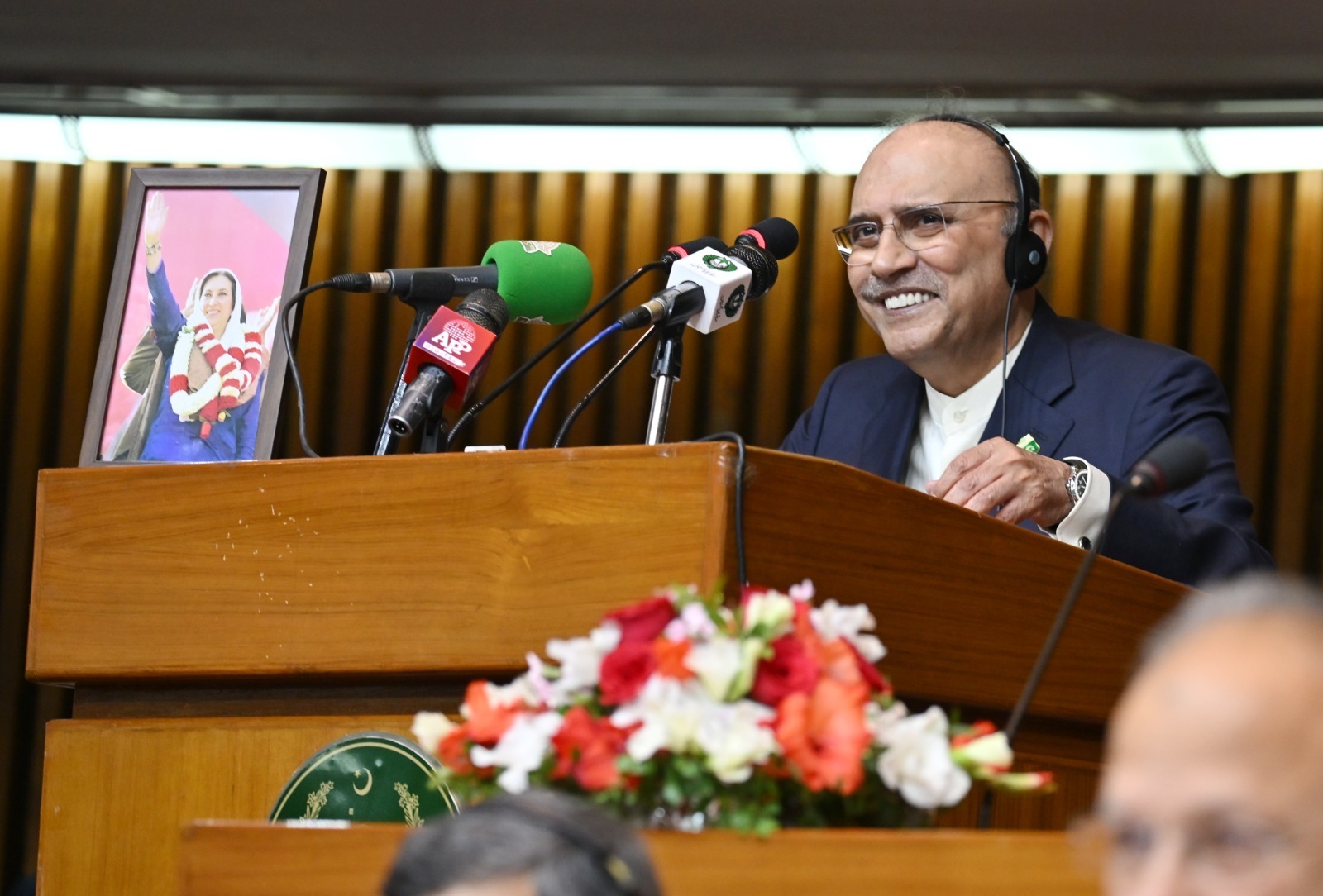
In a stirring address to the joint session of Parliament, President Asif Ali Zardari illuminated a path forward for Pakistan, one that is paved with consensus, investment, and a commitment to social and economic justice. As the nation embarks on a new parliamentary year, Zardari's words resonate with a sense of urgency and hope, urging lawmakers to rise to the occasion and fulfill the aspirations of the people.
With eloquence and conviction, President Zardari emphasized the importance of empowering citizens and making decisions of national significance through collective agreement. “Our people have pinned their hopes on parliament, and we must rise to meet their expectations,” he declared, reminding the assembly of their duty to strengthen democracy and restore public confidence in the rule of law. His call for good governance and political stability is not merely a political mantra; it is a heartfelt plea for a brighter future for all Pakistanis.
The president's vision extends beyond mere rhetoric; it encompasses tangible actions aimed at fostering economic growth and job creation. He urged the government to reform the taxation system, advocating for a broader tax net that does not burden those already contributing but rather encourages every eligible citizen to participate in nation-building. This approach reflects a commitment to fairness and equity, ensuring that the fruits of progress are shared by all.
The president’s words carried the gravitas of a leader who has weathered storms, yet they shimmered with the optimism of a new dawn. “As we embark on this new parliamentary year,” he urged, “I call upon this House to empower the people, to make decisions of national importance with consensus, to encourage domestic and international investments for economic growth and job creation, and to foster social and economic justice.” It was a vision both bold and intimate, a blueprint for a Pakistan where every citizen, from the bustling streets of Karachi to the remote villages of Balochistan, could find their place in the sun.
At the heart of his address lay a profound belief in the power of unity. He called on parliament to transcend division, to forge national decisions through dialogue and shared resolve. “Our people have pinned their hopes on parliament,” he declared, “and we must rise to meet their expectations.” Here was a president who saw the legislature not as a battleground of rival factions but as a sacred space where the nation’s dreams could take root. His plea for consensus was a bridge over troubled waters, an invitation to lawmakers to set aside narrow goals and embrace a collective purpose that binds the federation together.
But this was no mere rhetoric of unity—President Zardari’s vision pulsed with the promise of economic vitality. He urged the parliament to fling open the doors to investment, both from within and beyond Pakistan’s borders, as a catalyst for growth and opportunity. “We should avoid downsizing and job cuts,” he insisted. “Instead, our focus should be on creating jobs and utilizing trained manpower productively.” In his words, one could almost see the factories humming, the markets bustling, and the youth stepping boldly into a future brimming with possibility. He spoke of diversifying exports with value-added goods, of making the IT industry a cornerstone of economic progress, envisioning “digital and information highways” and IT parks that would propel Pakistan into the global arena.
Yet, the president’s ambition soared highest when he turned to the twin pillars of social and economic justice. “We must ensure that no province, no district, no village is left behind,” he proclaimed, his voice a beacon for the marginalized and forgotten. He called for a Pakistan where development is not a privilege for the few but a right for all—a land where infrastructure rises, schools flourish, and healthcare reaches every corner. His was a dream of fairness, of a reformed taxation system that expands the net without breaking the backs of those who already contribute. “Increase salaries and pensions, reduce income taxes on salaried classes, lower energy costs,” he urged, painting a picture of relief for the common man, the laborer, the salaried worker buckling under inflation’s weight.
The president’s address was a new hope to the people of Pakistan, particularly its women and youth. He spoke of empowering women, who form nearly half the population yet linger in the shadows of underrepresentation. Echoing the legacy of Shaheed Mohtarma Benazir Bhutto, he called for financial independence for those at the bottom of the social pyramid, urging an expansion of the Benazir Income Support Programme to lift millions from poverty’s grasp. For the youth, he offered hope and inspiration, insisting that “children are not outside schools” and that higher education and research become the bedrock of a knowledge-based economy. “They need hope and inspiration,” he said, and in his voice, one could hear the dreams of a generation taking flight.
This was not a speech blind to challenges. The president acknowledged the strains on the federation, cautioning against unilateral policies like the controversial canals project that have sparked dissent among provinces. “As your president, I cannot support proposals that divide us,” he said firmly, urging the government to seek consensus with all stakeholders. Yet even here, his tone was one of possibility, a belief that through cooperation, sustainable solutions could be found. His appreciation for the government’s economic strides—surging foreign exchange reserves, a booming stock market, a policy rate slashed from 22% to 12%—served as proof that progress is not a distant mirage but a reality within reach.
As the session drew to a close, presided over by Speaker Sardar Ayaz Sadiq and Chairman Senate Syed Yousaf Raza Gilani, with Prime Minister Shehbaz Sharif and a host of dignitaries in attendance, President Zardari left his audience with a charge: “Let us strive to build a Pakistan that is just, prosperous, and inclusive.” It was a summons to action, a reminder that the parliamentary year ahead is not just a span of time but a canvas of opportunity. The challenges are real—economic hardships, governance gaps, the shadows of division—but so too is the potential for transformation.
In the quiet aftermath of his address, there lingered a sense of quiet optimism. The president had not merely outlined a path; he had lit it with the torch of possibility. He spoke of a Pakistan where governance is good, where stability is a birthright, where the rule of law stands unshaken. He spoke of a nation where the fruits of progress are shared equitably, where the federation stands as one. As the lawmakers dispersed and the nation turned its gaze forward, his words echoed like a promise: “Pakistan always comes first.” And in that promise lies the hope that, together, Pakistan can rise—a land just, prosperous, and forever united.
No comments yet.