Navigating Challenges: The CPA Conference's Focus on Health, Education, and Technology
Strengthening Democracy: Highlights from the CPA Conference in Lahore
LAHORE: The two day Commonwealth Parliamentary Association (CPA) South-East Asia Regions Joint Conference concluded on Friday with the adoption of the historic Lahore Charter. The Charter, presented by Speaker of the Punjab Assembly Malik Muhammad Ahmad Khan, underscores the collective commitment of parliamentary leaders from across the region to strengthen democracy, promote inclusive growth, and advance sustainable development.
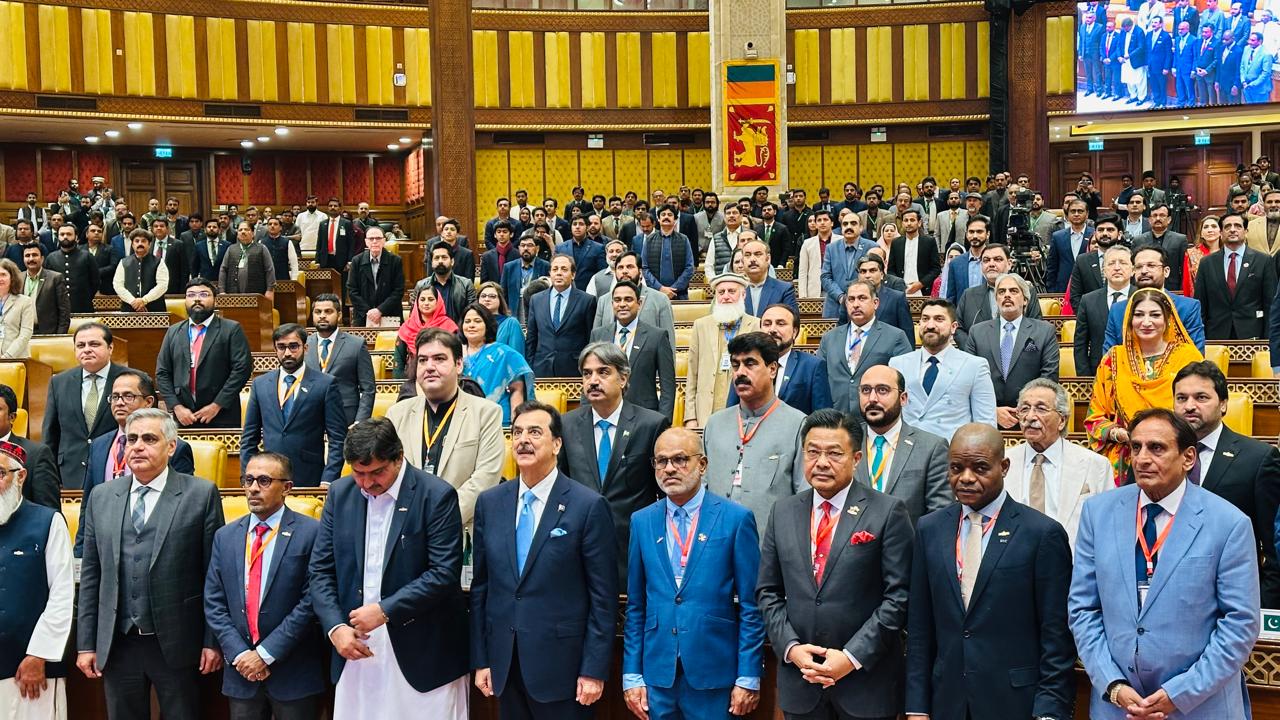
The conference, hosted by the Provincial Assembly of the Punjab in Lahore, brought together Speakers, Presiding Officers, and Delegates from CPA branches across Asia and South-East Asia. Acting President of Pakistan, Syed Yousuf Raza Gilani, was the guest of honor at the closing ceremony.
The Lahore Charter serves as a roadmap for addressing pressing regional challenges, including climate change, socio-economic disparities, and the impact of rapid technological transformation.
Acting President of Pakistan, Syed Yousuf Raza Gilani, was the guest of honor at the closing ceremony. He highlighted the significance of addressing climate change, pollution, technological advancements, and comprehensive social and economic development. Gilani emphasized that these challenges require regional cooperation and a collective approach.
Gilani commended the conference's success, noting that it brought together over 100 distinguished delegates, 12 speakers, 4 deputy speakers, and representatives from 22 legislatures in Malaysia, Maldives, Sri Lanka, and Pakistan. He emphasized the importance of cooperative governance, highlighting its necessity for fulfilling the aspirations of marginalized and vulnerable populations.
The acting president praised the efforts of CPA Secretary-General, Speaker Malik Muhammad Ahmad Khan, and Chief Minister Maryam Nawaz, stating that their leadership and efforts made the conference's success possible. He discussed the key issues addressed during the conference, including climate change, pollution, technological advancements, and comprehensive social and economic development.
Gilani stressed that these challenges require regional cooperation and collective strategies, rather than being limited to national borders. He emphasized the significance of health and education, calling them the foundation of a fair and prosperous society. The acting president also highlighted the urgent need for action to address climate change and technological advancements.
Gilani advocated for empowering local governments, noting that they connect people directly to decision-makers, improve accountability, and provide opportunities for diverse voices to be heard. He urged parliamentarians to reduce differences and create laws that cater to the needs of the people, promoting sustainable governance.
On the second day of the CPA Conference, Provincial Minister for Local Government Zeeshan Rafiq shed light on the issues and solutions related to the local government system. He stated that the biggest challenge facing the local government system is the lack of continuity. He mentioned that Punjab Chief Minister Maryam Nawaz Sharif initiated efforts to improve the local government system within her first month in office.
Under the vision of the Punjab Chief Minister, the local government system has been extended to the village level in Punjab. The province now collects 60 tons of waste daily, whereas in the past, only 14 to 15 tons were collected. A "Suthra Program" has also been launched for cleanliness in rural areas.
During the second session of the conference, Punjab Assembly Speaker Malik Muhammad Ahmad Khan and Chairman Public Accounts Committee Syed Ali Haider Gilani also addressed the participants.
Gilani emphasized that strengthening the local government system is a critical need of the time. He described the local government system as the best nursery for democracy, where leadership emerges.
Karachi Mayor Murtaza Wahab stated that the local government system brings improvement to the lives of ordinary citizens. He highlighted that Karachi's revenue has been tripled, and quotas have been allocated for transgender individuals, youth, women, and minorities in the Karachi Metropolitan City.
Maryam Aurangzeb, Senior Minister of Punjab, stressed on understanding the gravity of climate change and environmental pollution. Aurangzeb noted that Pakistan is among the countries severely affected by climate change, with future challenges including water scarcity.
Aurangzeb also stressed that environmental pollution is a critical issue being addressed through various measures. In Punjab, steps are being taken to mitigate the effects of climate change, and policies are being formulated to counter its negative impacts. She mentioned that industries are being mapped in Punjab, and efforts are underway in various cities to prevent environmental pollution.
To combat environmental damage, Aurangzeb underscored the need for institutional reforms, highlighting the coding of brick kilns that contribute to pollution. She also emphasized the importance of emergency measures to protect the environment. In Punjab, brick kilns are being shifted to modern technology, and a zero-tolerance policy has been adopted for the use of plastic bags.
Member of the National Assembly Khawaja Izhar-ul-Hassan remarked that the local government system is the foundation of democracy. He praised the CPA Conference as an excellent forum for understanding the local government systems of different countries.
Chairman of the Standing Committee of Punjab Assembly on Agriculture Zulfiqar Ali Shah noted that no one speaks about the local government system as passionately as Ahmed Iqbal. He stated that the local government system is the best mechanism for delivering services worldwide. In countries like Pakistan, with limited resources, it is essential to strengthen the local government system.
Participants at the conference stressed the need to reduce bureaucratic powers to strengthen the local government system. They emphasized that both political leadership and bureaucracy must work together for the system's success.
An important session of the CPA Conference, chaired by Punjab Assembly Speaker Malik Muhammad Ahmad Khan, was held to discuss parliamentary reforms, with a particular focus on legislation for artificial intelligence (AI), digital cooperation, and social media governance. The session emphasized the need for modern legislative measures to address emerging challenges in the digital age.
During the meeting, participants discussed the use of artificial intelligence to ensure transparency and accountability in social media content. The session also explored legislative solutions and advanced strategies to combat the spread of fake news and hate speech on social media platforms. Additionally, the importance of regional cooperation in digital governance and social media regulation was highlighted, with proposals to establish standards across Asia and Southeast Asia.
Deputy Speaker of the British House of Commons, Mrs. Nusrat Ghani, addressed the session, shedding light on the significance of digital governance. Punjab Assembly Member Hina Pervaiz Butt contributed to the discussions by sharing insights on media regulation and parliamentary reforms. Senator Anusha Rehman Ahmad Khan spoke about the challenges of social media governance, while experts emphasized the need for a policy framework to ensure the ethical and responsible use of AI in public services.
Former Minister Mr. Khurram Dastgir Khan shared his perspectives on digital policies, and AI expert Dr. Muhammad Shoaib Farooq elaborated on the practical applications of artificial intelligence. The session concluded with a call for collaborative efforts to address the challenges and opportunities presented by AI, digital transformation, and social media governance.
The CPA Conference on Health and Education held a crucial meeting focusing on legislation for comprehensive social development. During Session B, discussions centered on eliminating disparities in health and education. Emphasis was placed on enacting laws to ensure the provision of quality healthcare facilities in underserved areas.
The session was presided over by Parliamentary Secretary for School Education, Nosheen Adnan. Provincial Minister for School Education and Higher Education, Rana Sikandar Hayat, presented key points on improving the education system, reducing dropout rates, and implementing reforms in the education sector.
Minister for Specialized Healthcare, Khawaja Salman Rafiq, shared his views on comprehensive legislation to address social determinants of health. MNA Shahida Begum and Senator Rana Mahmood ul Hassan highlighted successful reforms in health and education at both national and provincial levels.
Assembly members from Balochistan, Farah Azeem, and Sindh, Makhdoom Fakhar Zaman, shed light on the challenges faced by their respective provinces. Farah Azeem, representing the CPA, which includes 56 countries, emphasized that collaborative efforts among member nations can bring revolutionary changes. She also commended Punjab Chief Minister Maryam Nawaz Sharif for her governance.
Vice Chancellor of King Edward Medical University, Professor Dr. Mahmood Ayaz, discussed modern reforms in the health sector. The session concluded with a Q&A segment addressing legislative measures in health and education.