
China: An Ironclad Friend Of Pakistan
As Wang stated, “As an ironclad friend and an all-weather strategic partner, China understands Pakistan’s legitimate security concerns and supports its efforts to safeguard sovereignty and security interests.”
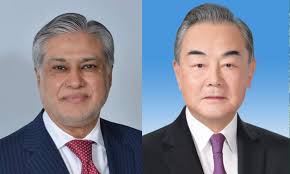
According to Xinhua, Chinese Foreign Minister Wang Yi recently informed Mr. Dar that China is closely following the developments between Pakistan and India.
He reiterated China’s unwavering support for Pakistan’s strong counterterrorism initiatives.
As Wang stated, “As an ironclad friend and an all-weather strategic partner, China understands Pakistan’s legitimate security concerns and supports its efforts to safeguard sovereignty and security interests.”
Wang also highlighted the need for a swift, impartial investigation, stressing that conflict harms the fundamental interests of both India and Pakistan and does not contribute to regional peace and stability.
He expressed hope that both countries would act with restraint, seek common ground, and work together to de-escalate tensions.
In a separate call with UK Foreign Secretary David Lammy, Mr. Dar discussed what he termed “India’s false accusations, baseless propaganda, and unilateral actions,” affirming Pakistan’s strong commitment to promoting peace and stability in the region.
The UK Foreign Secretary underscored the importance of resolving issues through dialogue and peaceful means, according to a statement from the Foreign Office.
Mr. Dar appreciated this approach and conveyed Pakistan’s readiness to participate in an independent and transparent investigation to clarify the facts.
Both leaders agreed to keep the lines of communication open as the situation evolves.
Call for an International Commission
Meanwhile, Defence Minister Khawaja Asif urged India to stop making unfounded allegations against Pakistan.
Speaking to reporters in Sialkot, he called on the UN Security Council and key regional players to investigate the Pahalgam incident, warning that a conflict between two nuclear powers could threaten global peace.
Asif suggested forming an international commission to look into the matter, recommending that the UN consider including countries like China, Russia, Iran, and Arab nations, noting that the UK has a historical understanding of the region due to its colonial past.
He also accused Indian Prime Minister Narendra Modi of staging a political drama to divert attention, akin to what he did after the Pulwama incident in 2019.
Call with the Iranian President
In a conversation with Iranian President Masoud Pezeshkian on Saturday, Prime Minister Shehbaz discussed Pakistan’s position regarding India’s provocative actions.
He expressed a desire for peace in the region and welcomed any potential role that Iran might play in achieving it.
According to a statement from the PM's Office, the two leaders exchanged views on recent regional developments and extended invitations to each other to visit their respective countries.
Regarding India’s unilateral decisions related to the Indus Water Treaty, Prime Minister Shehbaz condemned the weaponization of water resources, asserting that Pakistan would defend its rights without compromise.
He reiterated Pakistan's condemnation of all forms of terrorism and maintained that Islamabad has no direct or indirect links to the Pahalgam attack, showing readiness for a neutral investigation.
PM Shehbaz also expressed condolences for the tragic explosion in Bandar Abbas that resulted in numerous fatalities and left over 500 injured.
He affirmed that Pakistan stands with the Iranian people during this difficult time and is prepared to offer any assistance possible.
Separately, reports indicated that PM Shehbaz Sharif had met with his elder brother, Nawaz Sharif, head of the PML-N, at Jati Umrah on Sunday to brief him on the Pahalgam incident and its aftermath.
However, there has been no official confirmation from the PM's Office or PML-N representatives regarding this meeting.
No comments yet.